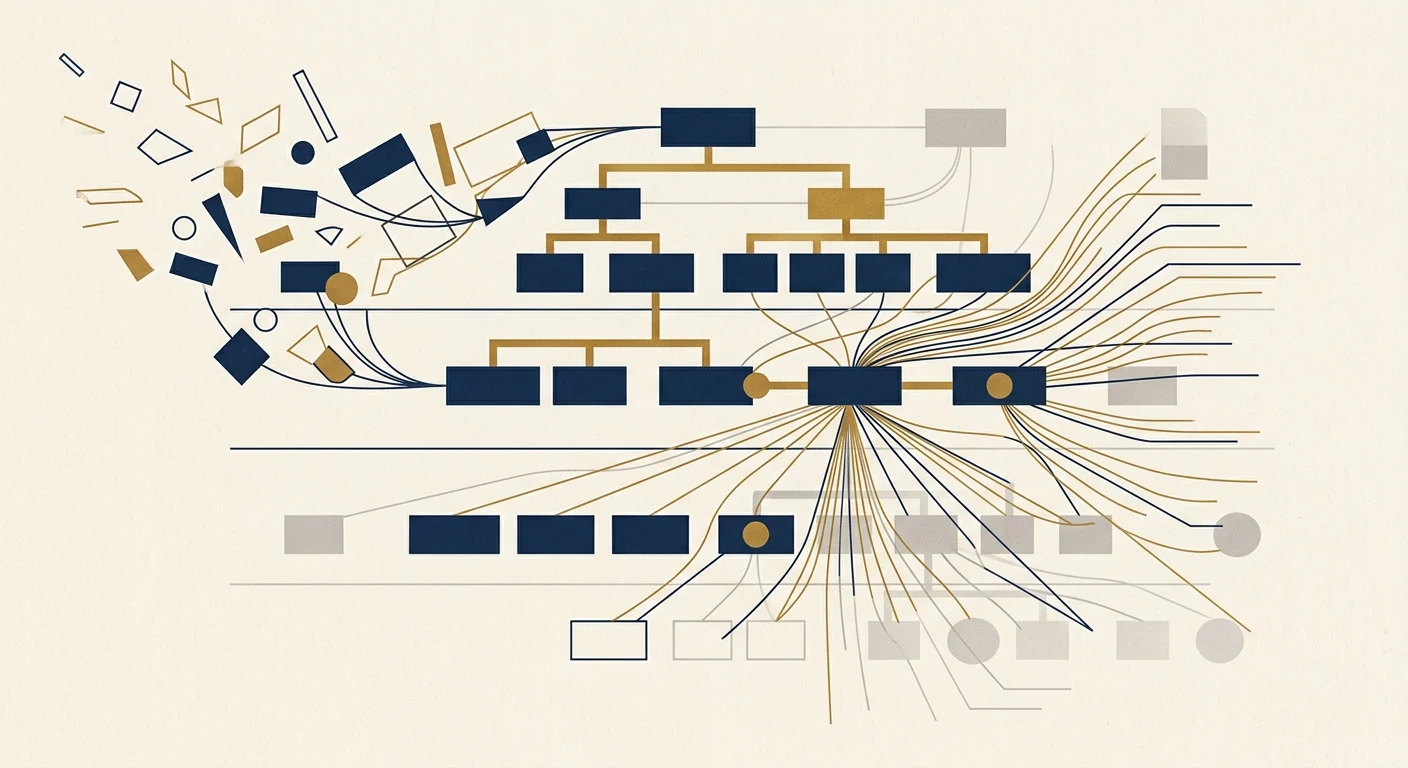
- GEO/ASO optimise for extraction quality and citation accuracy — not ranking position in a list of links.
- Four structural properties of citation-worthy content: a canonical main claim, defined key concepts, attributed evidence, and machine-readable structure.
- Reported AI Overview prevalence varies by query set, country, and tracker — industry estimates range broadly; BrightEdge’s tracked query set reported approximately 48% by February 2026 (BrightEdge, 2026); AI-referred traffic converts at ~6× non-branded organic (Webflow, 2025).
- Anthropic's Claude weights entity authority, factual accuracy, and structured data when selecting citations — not domain authority alone.
- GEO is a whole-of-entity strategy: AI systems synthesise signals from your website, LinkedIn, YouTube, third-party reviews, and forum discussions — not a single page.
What GEO and ASO Mean — and Why the Distinction Matters
Generative Engine Optimisation (GEO) is the practice of structuring web content so that large language model (LLM)-powered search engines and AI assistants retrieve, quote, or paraphrase it accurately in generated responses. AI Search Optimisation (ASO) is the broader discipline: it encompasses GEO but also covers discoverability, attribution integrity, and content longevity within AI-mediated information environments.
The distinction from traditional SEO is structural, not cosmetic. SEO optimises for ranking signals — backlinks, keyword density, click-through rate — that determine placement in a list of links. GEO and ASO optimise for extraction quality: whether an AI system can identify your content as a high-confidence source, lift a precise claim from it, and attribute that claim correctly. A page can rank on page one of Google and still be invisible to generative AI if its content lacks the epistemic markers that AI retrieval systems reward.
"GEO and ASO are not refinements of SEO. They are a separate optimisation target, triggered by a structural change in how information is surfaced to end users."
There is a second, equally important distinction: GEO is not a page-level strategy — it is a whole-of-entity strategy. When an AI system answers a question about your organisation, it does not read your website. It synthesises signals from your entire digital presence: your website, LinkedIn, YouTube, third-party reviews, forum discussions, and every publication that references you. Your brand is effectively a distributed dataset. The web's consensus about you is what AI systems treat as the source of truth — not what you say about yourself on a single page.
The Mechanism: How Generative AI Systems Select and Cite Sources
To optimise for AI citation, it helps to understand the retrieval pipeline. Generative AI search systems — including those powering Google's AI Overviews, Microsoft Copilot, and Perplexity — typically operate through a retrieval-augmented generation (RAG) architecture. In RAG, a retrieval component fetches candidate documents from an index; a generation component synthesises a response using those documents as grounding context.
The retrieval component scores documents against several factors. Based on published research and technical documentation from AI search providers, the primary signals include:
- Semantic relevance: Does the document address the query topic at the concept level, not just the keyword level?
- Structural clarity: Are claims segmented into discrete, extractable units (headings, lists, short paragraphs)?
- Source credibility signals: Are statistics attributed? Are claims distinguished from opinion?
- Factual density: Does the document contain verifiable, citable claims, or is it primarily padded prose?
- Provenance markers: Is authorship, date, and publication context visible in the page structure?
The generation component then selects from retrieved documents based on a confidence weighting. Content that is structurally ambiguous, factually unanchored, or epistemically flat — meaning it asserts without evidencing — scores lower in that weighting. This is why content written purely for human reading experience, with long narrative paragraphs and no structural hierarchy, is frequently bypassed even when it is substantively accurate.
Four Structural Properties of Citation-Worthy Content
The following properties are derived from the AI Knowledge Signal Framework developed by AI Knowledge Signal. They represent the minimum structural conditions for content to be reliably retrievable and citable by generative AI systems.
1. A Canonical Main Claim
Every article must be anchored by a single, unambiguous claim — one sentence that states what the page asserts. This serves two functions: it forces conceptual precision in the writing, and it gives AI retrieval systems a clean extraction target. A page that argues multiple unrelated points or hedges its central thesis into vagueness is structurally indeterminate and will be treated as lower-confidence by generative models.
2. Defined Key Concepts
Concepts introduced in an article must be defined explicitly, in the first 25% of the content. Generative AI systems encountering an undefined term must either infer its meaning from context (introducing attribution risk) or discard the passage. Explicit definition eliminates that ambiguity and increases the probability that your framing — not a paraphrase — is what gets cited.
3. Attributed Evidence
Every statistic, research finding, or empirical claim must carry a source and year. Unattributed statistics are treated as asserted rather than evidenced, which reduces their citation weight. Attribution also functions as a provenance marker: it signals to the retrieval system that the page is operating in an evidential register, not an opinion register.
4. Machine-Readable Structure
Heading hierarchy (H2/H3), structured lists, pull quotes, and definition blocks are not stylistic choices — they are extraction affordances. AI systems parse structured content more reliably than flowing prose because each element maps to a discrete semantic unit. A heading followed by a short paragraph is a self-contained claim-plus-elaboration unit. A 400-word paragraph is not.
What GEO-Optimised Content Is Not
A frequent misreading of GEO is that it requires AI-friendly content to be simplified, listicle-formatted, or stripped of depth. This is incorrect. The requirement is structural clarity, not conceptual shallowness. Long-form, analytically dense content that is well-structured outperforms shallow content in AI retrieval because factual density and concept-bearing prose score positively in retrieval weighting.
Equally, GEO is not a licence for keyword stuffing with AI-related terms. Semantic retrieval systems evaluate topical coherence at the concept level. A page that repeats "AI search optimisation" in every paragraph without adding conceptual substance will be assessed as low-density, not high-relevance.
"Structural clarity is not the same as conceptual shallowness. Analytically dense, well-structured content is the target — not simplified prose optimised for skim-reading."
The Epistemic Discipline Requirement
GEO and ASO surface a deeper requirement that is rarely discussed in marketing contexts: epistemic discipline. AI retrieval systems are, in effect, automated credibility assessors. They are trained on corpora that reward clearly reasoned, evidenced, and precisely worded content. Content that conflates fact with inference, asserts without evidence, or uses vague hedging language is not penalised by a rule — it is simply outcompeted by content that does not.
This has practical implications for content strategy. The practices that produce citation-worthy content — source attribution, explicit claim structure, concept definition, epistemic labelling (distinguishing "the data shows" from "we interpret this as") — are identical to the practices of rigorous analytical writing. GEO and ASO are not a new set of tactics layered onto existing content. They require a different production standard.
A Structured Content Checklist for GEO Compliance
The following checklist represents minimum compliance criteria for content intended to be retrieved and cited by generative AI systems:
- One canonical main claim stated in the first 100 words
- All key concepts defined explicitly within the first 25% of the article
- H2/H3 heading hierarchy used consistently throughout
- Every statistic attributed with source and year
- Fact, interpretation, and inference distinguished explicitly where relevant
- At least one structured list for procedural or multi-point content
- Author name, publication date, and organisation visible in page metadata
- FAQ section present (minimum five questions) to capture conversational query formats
- No unsubstantiated superlatives or hype language ("transformative", "revolutionary", "unprecedented")
- Page reviewed against a claim-evidence map before publication
Provenance and Attribution Integrity
One of the least-discussed dimensions of GEO is provenance integrity — the question of whether an AI system, having retrieved and synthesised your content, attributes it correctly. Provenance failures occur when content is paraphrased without attribution, when a claim is lifted and reassigned to a different source, or when an AI system conflates your framing with a similar claim from another page.
Reducing provenance failure requires three practices. First, make the source of claims explicit within the body copy, not only in footnotes or metadata. Second, use distinctive, precise phrasing for your original frameworks or arguments — generic phrasing is more susceptible to conflation. Third, publish structured reference pages (glossaries, framework definitions) that establish your terminology as a canonical source for AI systems building their representation of a domain.
Platform-Specific Citation Logic in 2026
By April 2026, the "AI search" surface had fragmented into four distinct retrieval architectures, each with its own citation logic. A single GEO strategy will no longer perform across all four. Practitioners now optimise the foundational framework once, then layer platform-aware tuning on top.
- Google AI Overviews: reported prevalence varies substantially by query set, country, and tracker. BrightEdge’s tracked query set reported approximately 48% by February 2026 (BrightEdge, 2026); state the source and methodology whenever quoting a percentage. This surface still rewards established SERP authority and E-E-A-T signals — the foundations of strong technical SEO carry directly across.
- Google AI Mode (a separate ranking surface) reaches roughly 100 million monthly active users as of February 2026, with its own entity-recognition and multimodal ranking layer. Brand visibility on this surface depends on entity coherence across your full digital presence, not on individual page authority.
- Perplexity processes over one billion queries per month from a pre-built index. PerplexityBot builds the index by crawling ahead of time; Perplexity-User is a separate user-initiated fetch agent that retrieves pages at the moment a user submits a query. Crawl-eligibility precedes citation-eligibility: a misconfigured
robots.txtrule blocking PerplexityBot can exclude your content from this platform’s citation pool entirely. - Anthropic's Claude weights entity authority, factual accuracy, and structured data at citation time, not domain authority alone. Configuring
robots.txtcorrectly for ClaudeBot is a direct access lever.llms.txtis an emerging machine-readable convention worth testing, but is not yet a guaranteed citation lever.
The conversion economics make this work commercially worth the effort. Webflow reported in 2025 that AI-referred traffic converts at roughly 6× the rate of non-branded organic search. Even modest AI citation share materially outperforms much higher-volume keyword rankings on revenue.
Implications for Content Strategy
For marketing and content teams, the shift to GEO and ASO has strategic consequences that go beyond individual article formatting. Brands that produce high-volume, low-depth content to capture keyword rankings are building an asset base that performs poorly in AI-mediated search. The economics of content production are shifting toward depth, specificity, and evidential rigour — qualities that require more investment per piece but produce higher citation durability.
The competitive advantage in AI search is not content volume. It is content authority: a demonstrable, structurally-visible expertise on a defined topic area, maintained consistently over time. Organisations that establish themselves as high-confidence sources within a domain — through attribution, structure, and conceptual precision — are the organisations whose content will be surfaced when generative AI answers questions in that domain.
Last reviewed: May 2026 by Christopher Foster-McBride, Digital Human Assistants. Platform behaviour and AI Overview prevalence figures change frequently. Check the blog for updates.
Frequently Asked Questions
What is Generative Engine Optimisation (GEO)?
Generative Engine Optimisation (GEO) is the practice of structuring web content so that large language model-powered search engines and AI assistants retrieve, quote, or paraphrase it accurately in generated responses. It differs from traditional SEO in that it optimises for extraction quality and citation accuracy rather than ranking position in a list of links.
How is ASO different from GEO?
AI Search Optimisation (ASO) is the broader discipline that encompasses GEO. While GEO focuses specifically on how generative AI retrieves and cites content, ASO also covers discoverability, attribution integrity, and content longevity across AI-mediated information environments — including AI assistants, knowledge bases, and training corpus inclusion.
Does GEO-optimised content need to be short or simplified?
No. GEO requires structural clarity, not conceptual shallowness. Long-form, analytically dense content with clear heading hierarchy, attributed evidence, and explicit concept definitions outperforms shallow content in AI retrieval. The requirement is that depth is accompanied by structure — not that depth be sacrificed for readability.
What is the most important structural change a content team can make to improve AI citation rates?
The single highest-impact change is establishing one canonical main claim per article — a single sentence that states precisely what the page asserts. This gives AI retrieval systems a clean extraction target and forces the conceptual precision that generative models reward. Secondary to this: explicit concept definitions in the first 25% of the article and consistent H2/H3 heading hierarchy.
Why do AI systems sometimes fail to attribute content correctly?
Provenance failures in AI citation typically occur when content uses generic phrasing susceptible to conflation with similar pages, when claims are made without explicit source attribution within the body copy, or when key frameworks and terms are not defined on canonical reference pages. Reducing provenance failure requires distinctive phrasing for original arguments, in-body attribution, and the publication of structured glossary or definition pages that establish terminology as a domain-specific source.
Is traditional SEO still relevant if AI search is growing?
Traditional SEO remains relevant for click-based discovery, but its scope is narrowing as zero-click AI-generated answers capture a growing proportion of search traffic. SparkToro and Datos data from 2024 found that 58.5% of US Google searches ended without a click, with only 36% of searches generating traffic to the open web. Content strategies that rely solely on keyword ranking signals are increasingly exposed to this shift. A dual approach — maintaining technical SEO while building GEO-compliant content depth — is the current best practice.
Find out how AI systems represent you — then fix it.
The free AI Knowledge Signal Audit scores any public URL across five AI training readiness dimensions and returns a Corpus Survival Likelihood rating. The AI Knowledge Signal Framework — and the AI Knowledge Signal Chrome and Edge extension — give you the structure, audit, and re-score loop to fix what the audit finds.