
Generative Engine Optimisation (GEO) & AI Search Optimisation (ASO)
AI Knowledge Signal

Be the business AI recommends — AI Knowledge Signal

Be seen by customers in AI search, don't get filtered out.

AI systems are now the primary interface through which people access knowledge. The organisations that shape how they are represented inside those systems will define their industries.

What is GEO?

Generative Engine Optimisation (GEO) — also called AI Search Optimisation (ASO) — is the discipline of engineering how your organisation is represented in AI systems.

AI systems do not discover organisations through search ranking alone. They ingest, classify, and cite content based on structural, epistemic, and technical properties — properties most organisations have never had reason to optimise.

The AI systems your customers are asking
ChatGPT, Claude, Perplexity and Gemini
Customers working on laptops in a cafe, searching for what they need Three colleagues looking at a laptop together A team reviewing their AI visibility in the AI Knowledge Signal tool
See how it works
Traditional search · worldwide

Google still dominates the open web

~90% of all search engine queries still run through Google.

Google 90.02%
Bing 5.14%
All others 4.84%

Source: StatCounter Global Stats — Search Engine Market Share, April 2026

The shift · worldwide

People ask AI now — and ranking well is no longer the same as being quoted

Three numbers that changed the job.
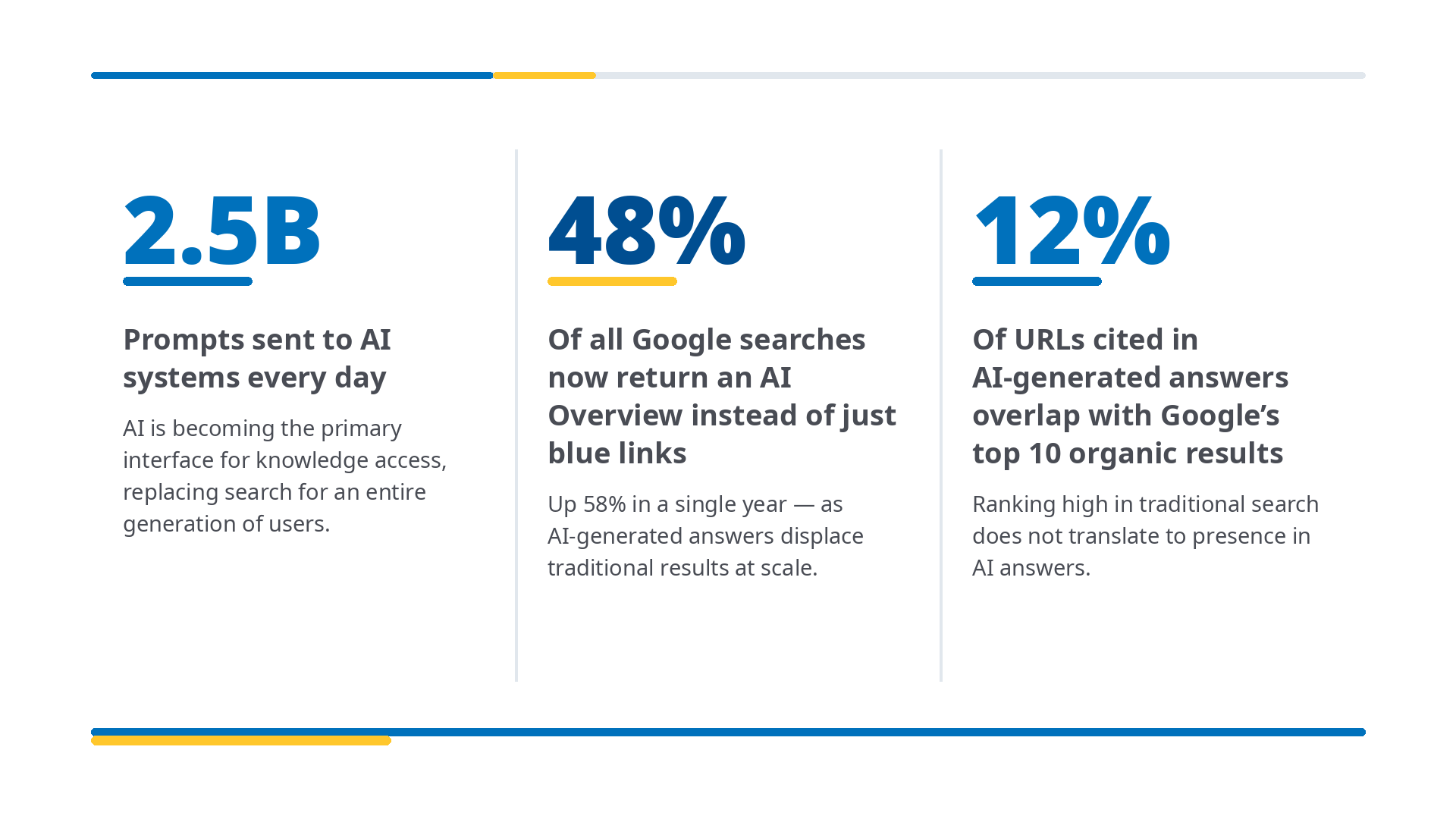
Three statistics: 2.5 billion prompts sent to AI systems every day; 48% of Google searches now return an AI Overview instead of just blue links; 12% of URLs cited in AI-generated answers overlap with Google’s top 10 organic results.

Sources: OpenAI figures via TechCrunch, 2025 · BrightEdge via Search Engine Journal, 2026 · Ahrefs AI Search Overlap Study, 2025

Why it matters

AI models are not trained on “the internet”

They are trained on carefully filtered, high-signal subsets of it, plus curated datasets. Most content never makes the cut.
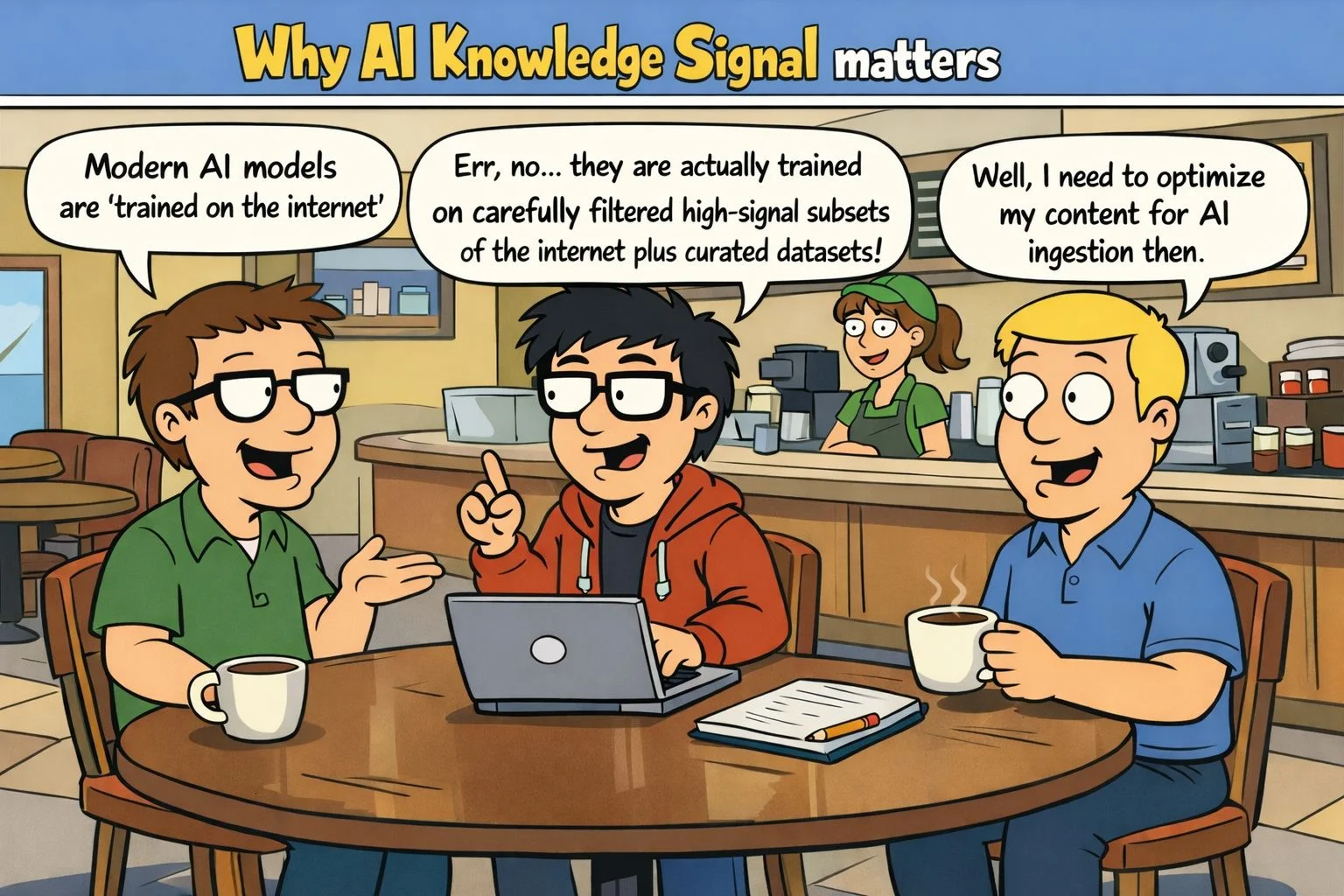
Three people in a café. One says ‘Modern AI models are trained on the internet’. Another corrects them: ‘They are actually trained on carefully filtered high-signal subsets of the internet plus curated datasets!’ The third replies: ‘Well, I need to optimise my content for AI ingestion then.’
User behaviour · Google search

AI summaries are eating the click

When an AI summary appears, users click a result roughly half as often.

No AI summary 15%
AI summary shown 8%

The query is answered on Google's page — outbound traffic to your site never happens. Being cited inside the answer is what now matters.

Source: Pew Research Center — AI summaries and search click-through, 2025

Note: a full-year analysis of 53 brands and 2.43 billion impressions (Seer Interactive, April 2026) found this AIO-related CTR decline reversed directionally in early 2026 — recalibrate against Q1 2026 actuals before setting H2 traffic targets; 2025-era decay models are no longer a reliable baseline.

AI assistant usage · worldwide

Measured by active users, ChatGPT has fallen below 50% for the first time as Gemini and Claude surge

The AI system answer leaderboard

ChatGPT 46.4%
Google Gemini 27.7%
Claude 10.3%
Grok, Perplexity & others <5%

ChatGPT still leads on raw scale (1.1B monthly users to Gemini's 662M and Claude's 245M) — but the answer layer is no longer a one-engine race. Being cited across all of them is what now matters.

Source: Sensor Tower — State of AI 2026 (via TechCrunch)

The answer layer

These are the systems answering your customers’ questions

Each one decides for itself what to read, believe, and repeat — so visibility has to be earned in all of them, not just one.
Logos of ChatGPT, Claude, Perplexity and Gemini.

A single cross-engine strategy is now a documented liability — the Framework structures your content for each engine's distinct preferences, confirmed across 1.13 million prompts (Goodie, June 2026) and a seven-month, seven-engine analysis (Conductor, May 2026).

AI chatbot referrals · worldwide

ChatGPT still leads the traffic it sends back

Of the visits AI sends to the open web, ChatGPT leads — but Gemini, Perplexity and Copilot are carving out share.

ChatGPT 76.85%
Google Gemini 9.00%
Perplexity 7.73%
Microsoft Copilot 3.76%
Claude 2.66%

Source: StatCounter Global Stats — AI Chatbot Market Share, April 2026

AI chatbot referrals · ChatGPT

And the AI layer is fragmenting fast

ChatGPT's share of AI referrals has fallen to a record low as rivals grow.

90% 80% 70% 84.21% 76.85% Apr 2025 Apr 2026

Source: StatCounter Global Stats — ChatGPT hits all-time low, April 2026

Market insights

Ahrefs AI Search Benchmark — Q4 ’25–Q1 ’26

What AI systems actually cite — and it isn’t the Google leaderboard.

  • AI citations no longer mirror Google rankings28.3% of ChatGPT’s top-cited pages have zero organic visibility.
  • Zero-click is accelerating — AI Overviews reduce clicks to top-ranking content.
  • Fresh content wins89.7% of identifiable ChatGPT-cited pages were updated in 2025.
  • YouTube is the strongest AI visibility signal — correlation of ~0.737.
  • “Best X” listicles dominate discovery43.8% of ChatGPT source URLs for top-of-funnel queries.

Source: Ahrefs — AI Search Benchmark Report, Q4 ’25–Q1 ’26

The method

AI Knowledge Signal Framework

A structured methodology for engineering how organisations are represented in AI systems.
Cover of the AI Knowledge Signal Publication Framework 2026.

Look inside the framework document →

The six phases

Crawlable, clear, original, credible, usable — then maintained

Each phase feeds the next, and the loop keeps running as the AI systems change.
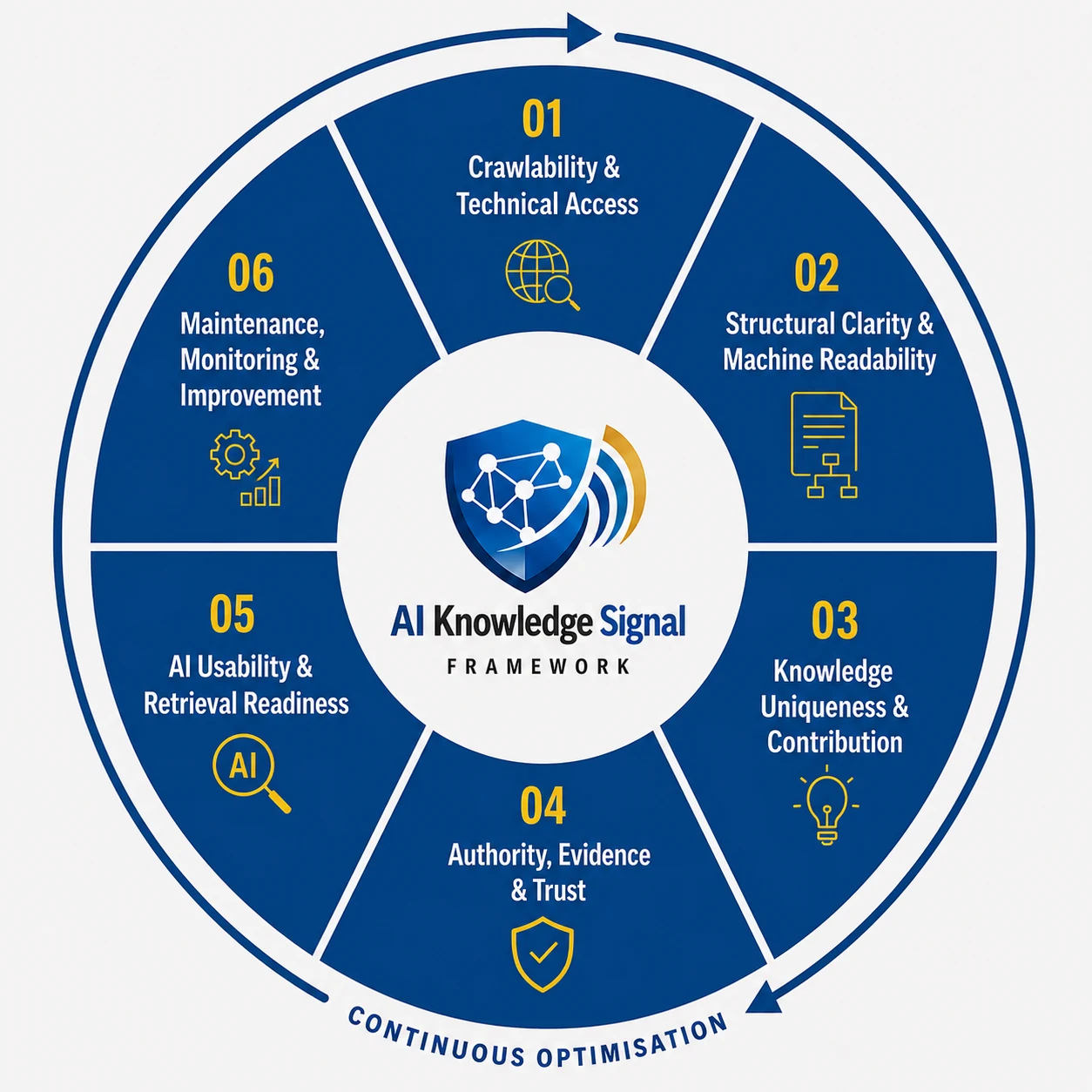
The AI Knowledge Signal Framework as a six-phase loop of continuous optimisation: 01 Crawlability & Technical Access, 02 Structural Clarity & Machine Readability, 03 Knowledge Uniqueness & Contribution, 04 Authority, Evidence & Trust, 05 AI Usability & Retrieval Readiness, 06 Maintenance, Monitoring & Improvement.
Self-assessment

How AI Systems Evaluate Your Organisation

  • Crawlability & Technical Access — Can AI systems reach, access, and ingest your content?
  • Structural Clarity & Machine Readability — Is your content shaped so machines understand what your organisation actually is?
  • Knowledge Uniqueness & Contribution — Are you contributing original knowledge, or just repeating what already exists?
  • Authority, Evidence & Trust — Are your claims credible, consistent, and verifiable across the web?
  • AI Usability & Retrieval Readiness — Can AI systems actually use, extract, and cite your content?
  • Maintenance, Monitoring & Improvement — Are competitors being cited instead of you, and are you improving over time?
The tool

The Chrome extension puts the framework to work

Score any page, check text you have written, upload a document, see how the big AI models describe you, and scan YouTube for your keywords.
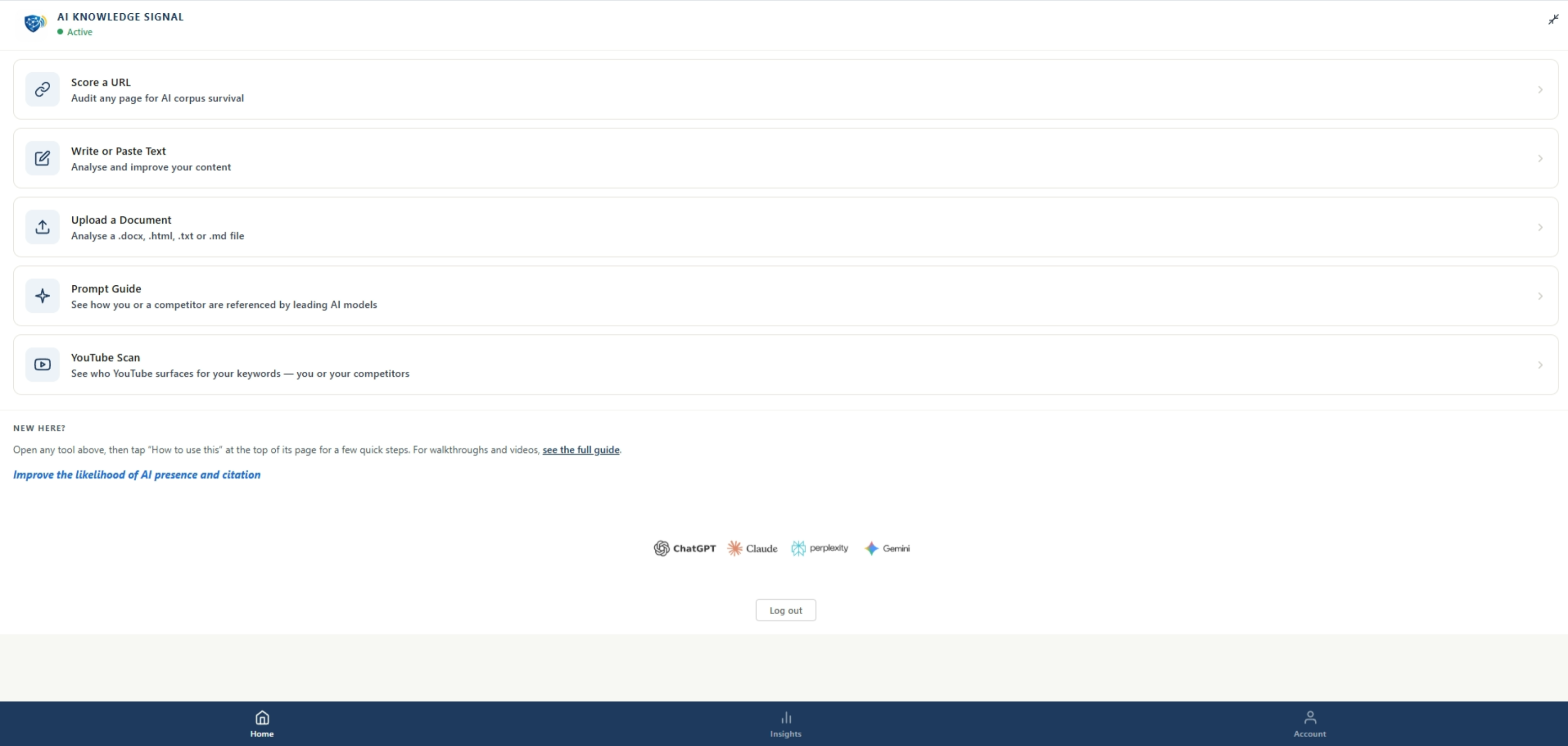
AI Knowledge Signal Chrome extension home panel listing five tools: Score a URL, Write or Paste Text, Upload a Document, Prompt Guide and YouTube Scan.
The result

Then you fix it — and watch the score move

Rewrite with the framework and score again. This page went from 1/10 to 7/10.
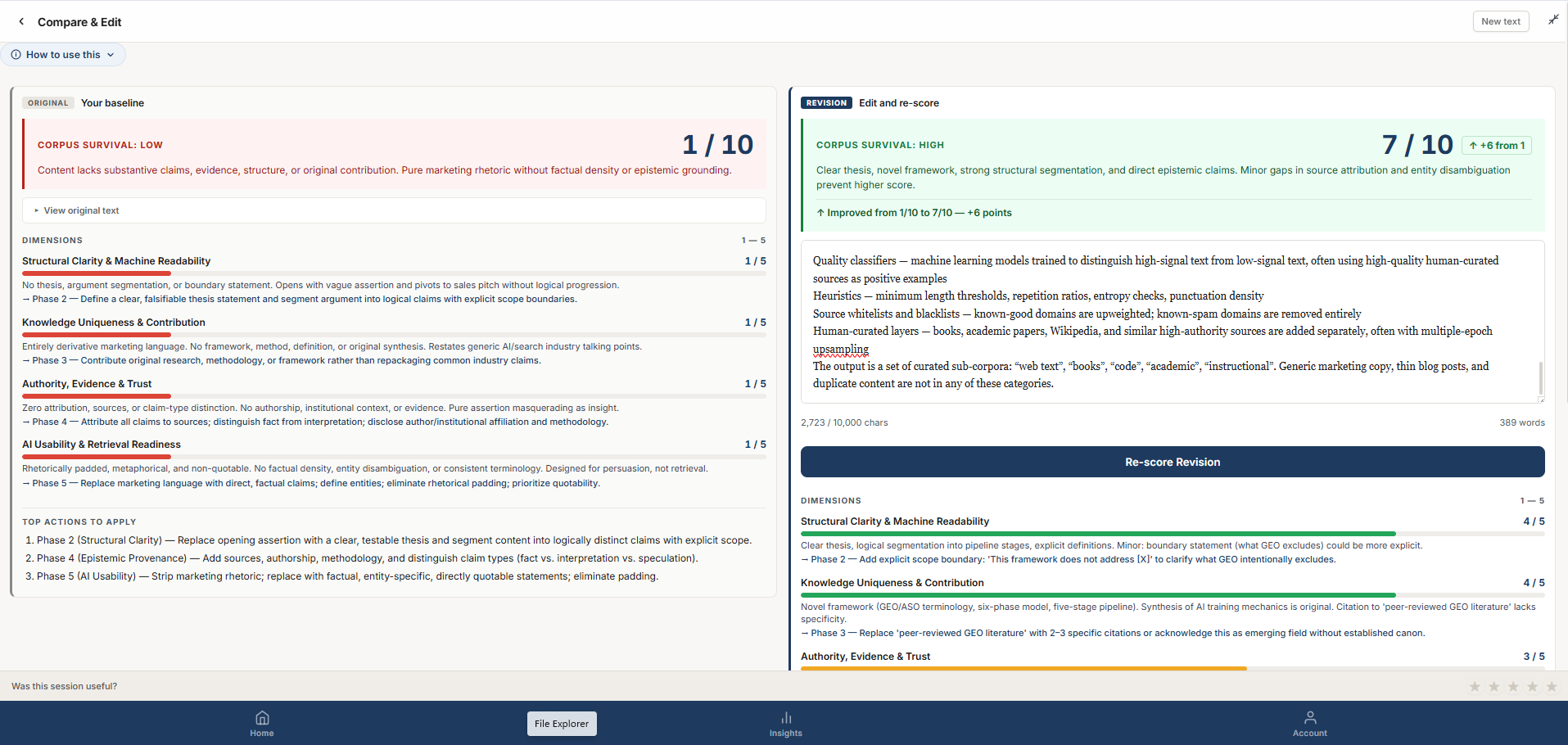
Compare and Edit view showing an original text scored 1 out of 10 for corpus survival beside a revision scored 7 out of 10, with dimension-by-dimension feedback.

Answer a few quick questions and we'll follow up with where to focus first — no obligation.

Free Audit

Audit your AI Knowledge Signal

Results in under 30 seconds

  • Enter any public URL.
  • The audit runs a technical pre-analysis — checking schema markup, heading structure, canonical tags, and metadata — then scores your content across five AI training readiness dimensions: Crawlability & Technical Access, Structural Clarity & Machine Readability, Knowledge Uniqueness & Contribution, Authority, Evidence & Trust, and AI Usability & Retrieval Readiness.
  • Returns a Corpus Survival Likelihood rating and a structured report with Framework phase priorities. Corpus Survival Likelihood is the estimated probability that a piece of content survives AI training data quality filters rather than being removed or down-weighted before model training.

One free audit per URL each month — re-audit any time to track your improvement. We'll email you the full report, and you can print or share it too. No spam; unsubscribe any time.

Free audit — partial analysis. This audit covers technical signals and the first 9,000 characters (~1,500 words) of your page — see FAQ for full methodology details. To score full-length content or unpublished drafts, use the Chrome and Edge extension and the framework which provides full suite of 170+ levers aligned to the AI Signal Publication 6-Phase Framework.
out of 10

This audit measures the readiness of the content you own. Third-party surfaces — Wikipedia, Reddit, review sites, news — shape AI visibility to a comparable degree (Goodie, 1.13M-prompt study, 23/06/2026), and are assessed separately.

Dimension Scores (5 = publication-grade)
Strengths
    Weaknesses
      Top Recommendation
      How to fix these issues
      Your priority framework phases are ready Activate the Chrome and Edge extension to unlock the exact phases to address — with the full 170+ lever checklist.
      Get Access — free trial, then $19.99/mo
      Step 2

      Do AI systems actually know you?

      Step 1 scored your page. This asks two AI systems who you are — Perplexity, which searches the live web, and Claude, which answers from what it learned in training. Being findable and being known are not the same thing.

      We’ll use the email you entered above. One free check per brand each month.

      Research basis: GEO: Generative Engine Optimization, Aggarwal et al., Princeton University (2024) · Navigating the Shift: Web Search and Generative AI Response Generation, Chen et al. (2026) · Evaluating Verifiability in Generative Search Engines, Liu, Zhang & Liang (2023)
      Interactive · per-engine strategy

      Do you know what AI Systems your users use to find your business and then where you need to focus?

      Read our Research & Evidence for more details.

      How we compare

      The AI-citation tool built for Australian budgets

      The big SEO suites bolt AI tracking onto enterprise plans, and the specialists are agencies on retainer. AI Knowledge Signal is a self-serve tool that scores your content for AI citation — affordably, with an Australian focus.

      Updated June 2026

      Product / service type AI-citation scoring YouTube content audit Pricing (entry) Self-serve tool Australia focus
      AI Knowledge Signal AI-citation audit tool — 6-phase framework YesScores citation-readiness, not just mentions YesPlannedAudits your own video for citation-readiness Free, then $19.99 / mo Yes Yes
      Ahrefs SEO suite + AI add-on (Brand Radar) Mention / share-of-voice tracking PartialTracks YouTube mentions as a source only ~$828 / mo for AI tracking Yes No
      Semrush SEO suite + AI add-on (AI Visibility Toolkit) Mention / share-of-voice tracking No $99 / mo add-on + paid base plan Yes No
      Peec AI GEO / AI-visibility analytics Mention + source-gap tracking PartialFlags YouTube as a citation source only ~€85 / mo (~$95), EU-priced Yes No
      Onely Technical-SEO / AI-search agency Service-delivered No Custom retainer (~$2,500+ / mo) No No
      iPullRank SEO / GEO agency (Relevance Engineering) Service-delivered No Custom / enterprise quote No No

      Competitor features and pricing as publicly listed, June 2026, and subject to change.

      Get access

      Start scoring your content for AI citation

      Free 30-day trial
      then $19.99/month or $200/year · or own the framework once for $2,500 with a free masterclass
      Choose Plan & Subscribe

      By subscribing you agree to the Terms of Sale — personal/organisational use only, no redistribution or resale.

      Signal — Monthly AI Knowledge Briefing

      One email a month. GEO, ASO, and AI knowledge publication insights.
      No marketing, no extras. Browse recent newsletter issues